
Bonne Terre Insights

Infrastructure intelligence for responsible data center growth.

Bonne Terre Insights helps developers screen sites, explain risk, and make defensible decisions before capital is committed.

Bonne Terre Insights investor view: a world map of 25 tracked data center facilities with a detail panel open for a 270MW Meta expansion in Clondalkin, Dublin, showing operator, capacity, grid utility, and estimated investment.
Bonne Terre Insights — investor view. Facility data shown for informational use; sourced from Baxtel and public permit records.

Why now

Siting mistakes are getting more expensive.

75+

U.S. data center projects blocked or delayed, Q1 2026

~$130B

Capital represented by those projects

$20M+

Schedule, legal, consultant, and opportunity cost exposed by a single failed or delayed site decision

First two figures: Data Center Watch, Q1 2026. The $20M+ figure is Bonne Terre Labs’ own framing and can exceed $20M per project.

Power, water, grid, land, and interconnection limits increasingly decide whether a site is viable. States and localities are adding community, ratepayer, and transparency safeguards. Investors, lenders, and public agencies now expect traceable support for material risk claims.

The market is moving from “Can we build here?” to “Can this project survive scrutiny, delay, and challenge?”
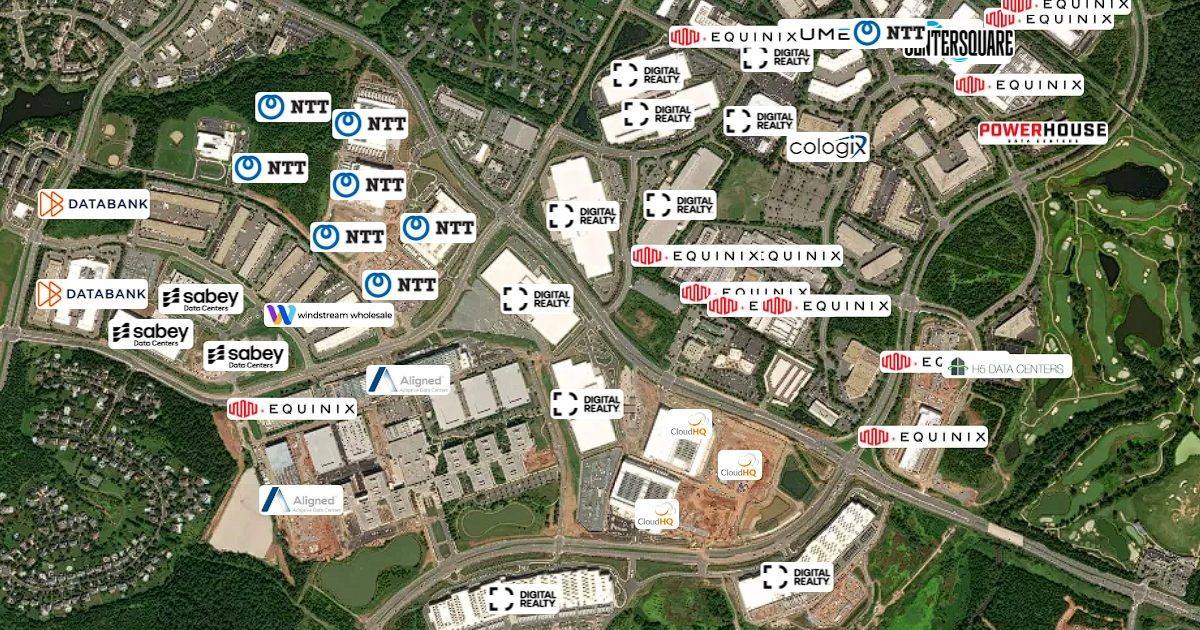
Aerial view of Data Center Alley in Loudoun County, Virginia, densely packed with facilities operated by Equinix, NTT, Digital Realty, Sabey, Aligned, CloudHQ and others.
Data Center Alley, Loudoun County, Virginia. Operator density on this scale is what makes siting, permitting, and community conditions decisive. Third-party marks belong to their respective owners.

How it works

We intervene before the cost structure hardens.

BTI INTERVENES HERE Screening, evidence, and consequence analysis before land acquisition, permitting, engineering, and major design commitments. 1 Site search → 2 Diligence → 3 Permitting → 4 Stakeholder challenge → 5 Delay / redesign / exit BTI INTERVENES HERE Screening, evidence, and consequence analysis before land acquisition, permitting, engineering, and major design commitments. 1 Site search 2 Diligence 3 Permitting 4 Stakeholder challenge 5 Delay / redesign / exit
When risk surfaces late, every downstream stage compounds schedule, legal, consultant, opportunity, and reputational cost.

Product

Bonne Terre Insights

Screen sites. Explain risk. Produce audit-ready diligence.

One evidentiary foundation

Integrates site, infrastructure, permitting, environmental, legal, community, and project evidence.

Community evidence intelligence

Multilingual media, source credibility, survey and native data, public records, and longitudinal signals.

Role-specific decision support

Preserves common facts while tailoring recommendations to the user, decision context, and risk tolerance.

The same evidence base is presented through role-based views — investor, regulator, community, and analyst — so each user sees the facts their decision turns on.
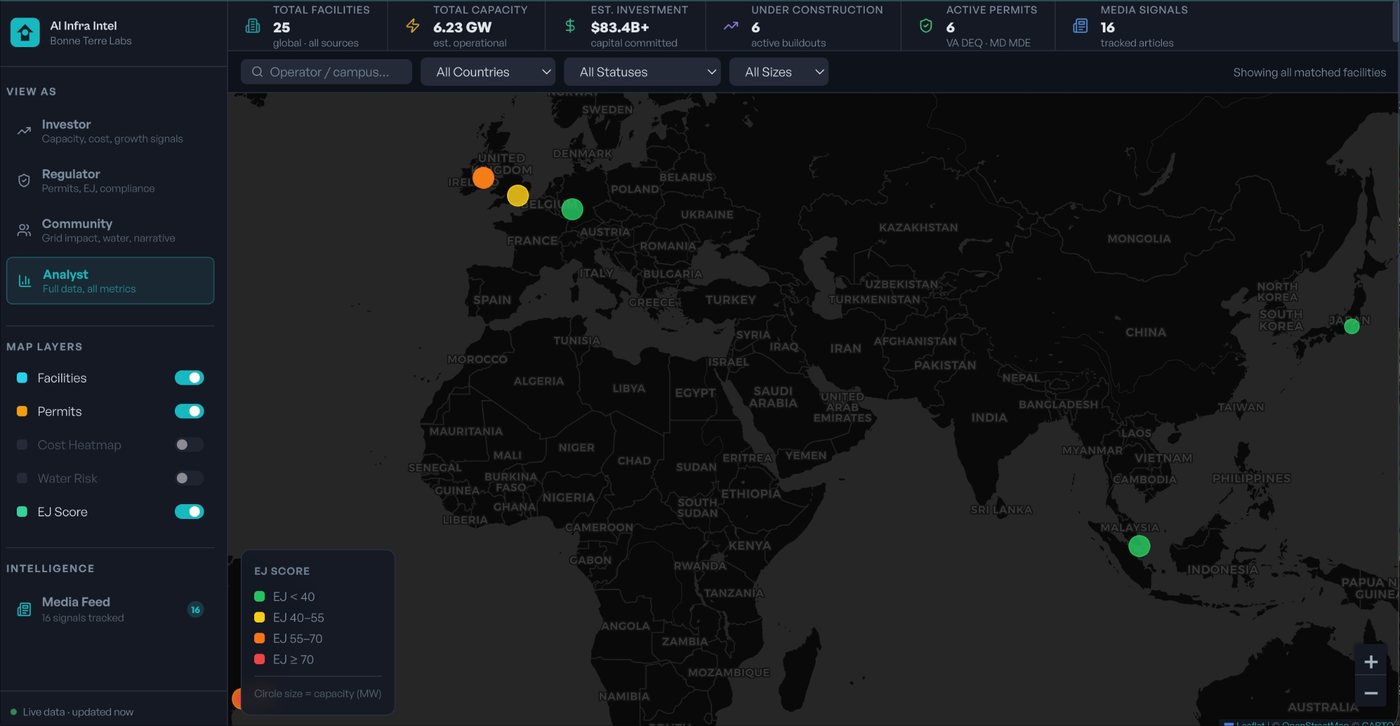
Bonne Terre Insights analyst view with the environmental justice score layer active, showing colour-coded facility markers and an EJ score legend.
Portfolio scale — analyst view, environmental justice score layer active. Role-based views surface the same evidence base for different decisions.

Screening then narrows to a single parcel, where the same evidence resolves into scored indicators — each carrying its source and vintage — and a written summary a diligence file can cite.

Bonne Terre Insights site record for a pre-development parcel: an overall siting risk score of 72, four scored indicators for environmental justice risk, digital infrastructure, investment context, and protest and legal exposure — each labelled with its source dataset — and a written executive summary.
Site scale — a single pre-development parcel scored across four indicators, each labelled with its source and vintage (CEJST 2025, FCC Fabric Q4 2024, EIA 2024, EPDA 2000–2024), alongside a written summary. Sample site record shown for illustration.

Capabilities shown include current, pilot, and in-development functions. Product status is available in diligence materials.

The stack

The moat is the evidence architecture.

Not any single dataset, and not the use of AI.

5 Decision & predictive intelligence What should this user do, and what is likely to change? 4 Financial accountability intelligence — extended through SEED What was promised, funded, and achieved? 3 Legal consequence intelligence What do these facts mean legally — harm, standard, consequence, future impact? 2 Community evidence intelligence What are affected communities experiencing, and how reliable is that evidence? 1 Site & infrastructure intelligence Can this site physically and operationally support the project? 5 Decision & predictive intelligence What should this user do, and what is likely to change? 4 Financial accountability intelligence — extended through SEED What was promised, funded, and achieved? 3 Legal consequence intelligence What do these facts mean legally — harm, standard, consequence, future impact? 2 Community evidence intelligence What are affected communities experiencing, and how reliable is that evidence? 1 Site & infrastructure Can this site physically and operationally support the project?
Read from the bottom up: layer 1 is the foundation. Evidence → interpretation → consequence → recommendation → forecast.

Who it’s for

Built for the teams making the call.

Developers & operators

Colocation data center developers and operators screening candidate sites before acquisition.

Infrastructure investors & lenders

Teams that need traceable support for material risk claims.

Development advisers

Environmental, engineering, and ESG advisers producing defensible diligence.

Typical buyers include VP or Director of Development, site acquisition leads, infrastructure investment leads, and ESG or risk executives.

Traction

Validated with the people closest to the problem.

200+

customer and stakeholder interviews — developers, operators, investors, ESG and risk leads, consultants, public agencies, and community stakeholders.

Programs & funding

NSF SBIR Phase I non-dilutive federal funding

  • LabStart
  • NVIDIA Inception
  • NSF I-Corps
  • Georgetown Tech Ventures

Pilot / design partner work

  • Garrison Data Partners site-screening workflow
  • City of Baltimore municipal review workflow

Discovery & ecosystem

  • Ramboll
  • Capgemini
  • Loudoun County
  • Esri
  • AWS
  • Virginia Tech
  • Xylem
  • Lambda
  • UNDRR

Relationship labels should be read literally: program, funding, pilot or design work, discovery conversation, or ecosystem relationship.

Team
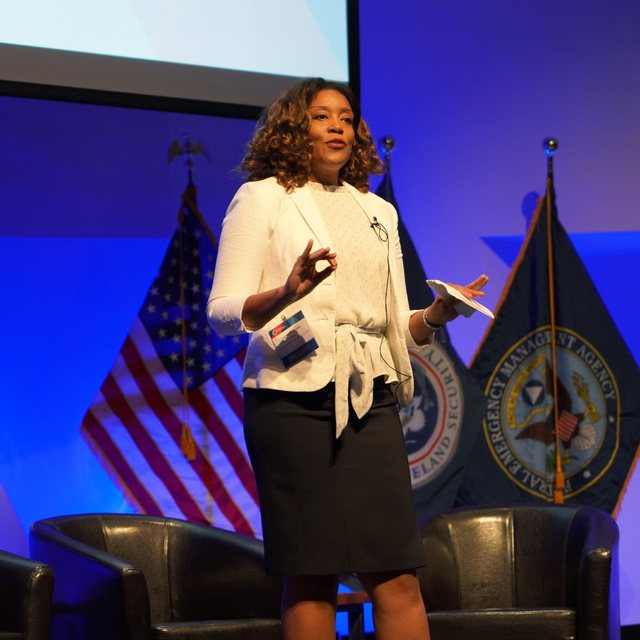
Founder-market fit across climate law, infrastructure risk, community research, engineering, and data science.

Monica Sanders, Founder and CEO of Bonne Terre Labs, speaking at a podium.

Monica Sanders, JD, LL.M.

Founder & CEO

Product vision, regulatory strategy, partnerships, and market development. Monica works at the intersection of climate law, disaster policy, and infrastructure risk, and leads Bonne Terre Labs’ approach to legal consequence and community evidence.

Core team

  • Portrait of Mariska Bogaard.
    Mariska Bogaard Climate Data & Research Lead

    Leads community-engaged research on environmental and climate justice. She turns qualitative and sociological research into tools communities can use.

  • Portrait of Joel Varghese.
    Joel Varghese Technical Lead, AI Research

    Builds NLP modules that extract insight from web-scale text. Holds a master’s from George Washington University, where he published research on transformer-based forecasting.

  • Gabrielle Lyandra Rodrigues Data Architecture Fellow

    Designs the data models, taxonomies, and system architecture behind Bonne Terre Insights. Brings 6+ years of enterprise engineering, including as Frontend Tech Lead at Itaú Unibanco.

  • Portrait of Keith Yu.
    Keith Yu Graduate Technical Research Associate

    Supports data pipelines, LLM evaluation, and data quality. A Georgetown Data Science and Analytics master’s student with prior work at Capital One and Cushman & Wakefield.

  • Portrait of Diego Sarria.
    Diego Sarria Graduate Technical Research Associate

    Supports data pipelines, LLM evaluation, and data quality. A Georgetown Data Science and Analytics master’s student with NLP research experience at the University of Chicago.

  • Portrait of Kendle Schooler.
    Kendle Schooler Climate & Tech Fellow

    Brings ecological research, GIS, and environmental justice to the team. She has used ArcGIS to study how neighborhood demographics relate to data center siting.

  • Portrait of Khai Wright.
    Khai Wright Web Development Intern

    Supports front-end and full-stack development, including the Bonne Terre Labs homepage rebuild. A Computer Science and Physics student at Temple University.

  • Portrait of Noha Yousif.
    Noha Yousif R&D Fellow

    Built the financial-report analysis behind the first SEED prototype. An Economics-Statistics student at Barnard College who supported the company through NSF I-Corps.

Advisors

  • Anne GibbonAI product, public sector
  • Sint MoeCommercialization, I-Corps
  • Jasmine Obas BurdetteProduct and engineering
  • Dave JacobsOperations

Make the case before the capital moves.

Bonne Terre Labs brings a defensible evidence layer to the infrastructure boom — helping capital move faster without ignoring the legal, environmental, and community conditions that determine durability.

Building A Sustainable Future

Request a Demo monica@bonneterrelabs.com

Request investor materials

Materials are shared by email on request, not published publicly.